Shirley Chisholm: “Anchored in proper Leadership”
Shirley Chisholm: “Anchored in proper Leadership”
$2,800.00
Medium: Acrylic
Transfer: Wood
Print Orientation: Portrait
Size: 26"x42"
Polycrylic Protective Finish
Weight: 17.4 .lbs
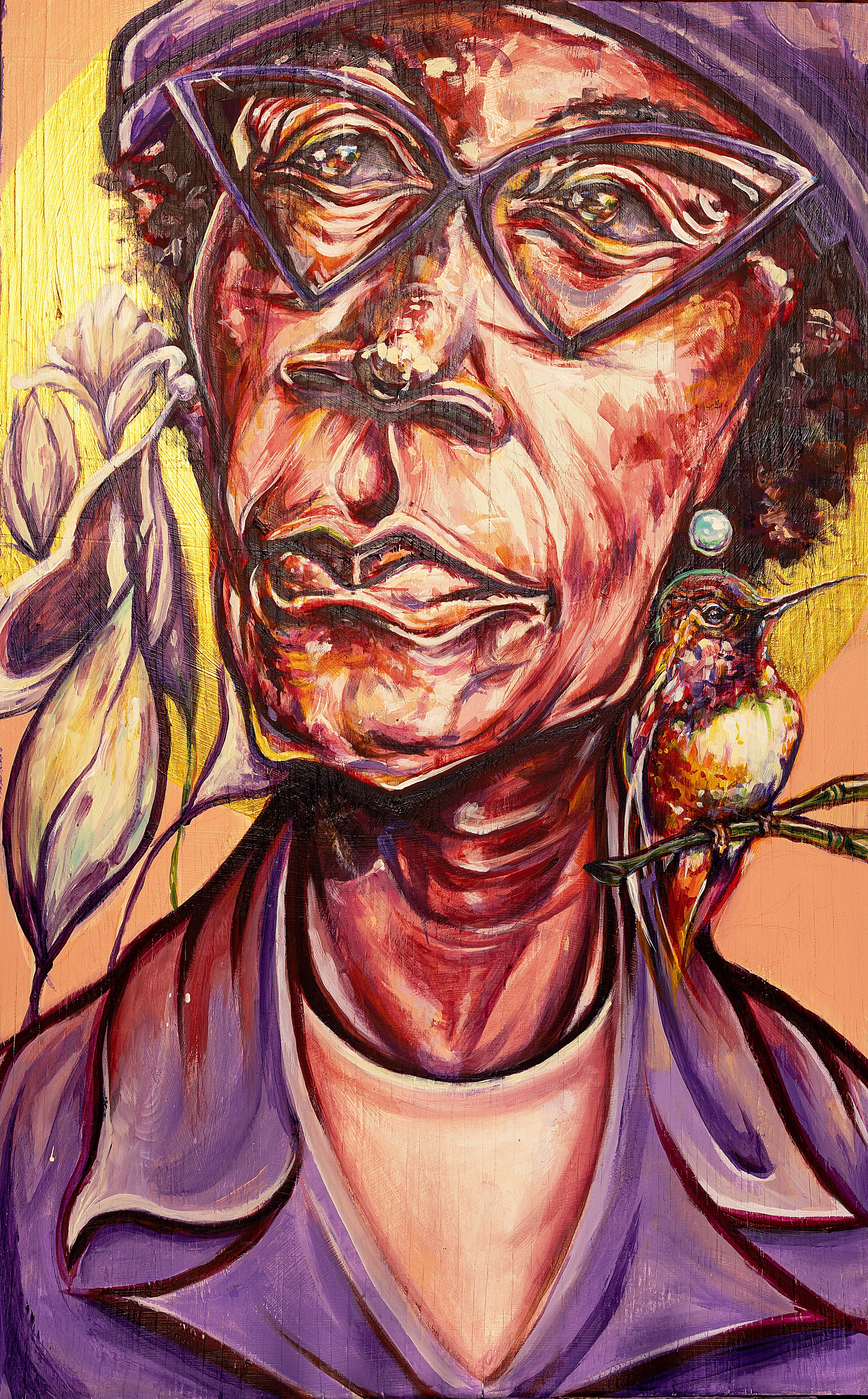
Anchored in Proper Leadership is a vibrant contemporary portrait honoring Shirley Chisholm as a figure of vision, courage, resilience, and principled leadership. The expressive palette and gestural brushwork transform the portrait from historical representation into an emotional landscape. A hummingbird rests beside her, symbolizing resilience, perseverance, spiritual vitality, and the freedom to rise beyond imposed limitations. Opposite it, the peace lily introduces a language of peace, purity, reconciliation, and renewal. Together, the two symbols establish a dialogue between movement and stillness, struggle and peace, courage and compassion. At the center, Chisholm’s unwavering gaze becomes the anchor: a metaphor for leadership grounded not in power alone, but in vision, conscience, and service.
Anchored in Proper Leadership is a commanding and emotionally charged portrait that presents Shirley Chisholm not simply as a historical figure, but as an embodiment of principled leadership, courage, dignity, and spiritual endurance. Artist Photographer Lorenzo Pickett employs an expressive acrylic vocabulary characterized by saturated reds, violets, oranges, yellows, and flesh tones, creating a work that feels simultaneously intimate and monumental.
The portrait's scale and vertical orientation reinforce its subject's stature. At 26 × 42 inches, Chisholm's face dominates the composition, compelling the viewer into a direct encounter with her gaze. Rather than presenting an idealized or overly polished likeness, Pickett embraces visible brushwork, energetic contours, layered color, and painterly fragmentation. This approach gives the portrait psychological presence: we are not merely looking at Chisholm; we are being asked to meet her gaze.
The Eyes: Vision as Leadership
The eyes are among the most powerful elements of the composition. They possess an almost jewel-like luminosity against the surrounding reds and violets. The unusual angularity of the glasses creates a visual frame within the frame, directing attention toward her eyes and, symbolically, toward vision.
This is particularly appropriate for a portrait of Chisholm. Her leadership was fundamentally visionary—she challenged political conventions and insisted that marginalized voices belonged within the highest levels of American political life.
The glasses can therefore be interpreted as more than a recognizable feature. They become a metaphorical instrument of clarity and discernment: the ability to see beyond the limitations of one's present circumstances and envision what others have not yet imagined.
The Color Language
Pickett's color choices are exceptionally important to the work's emotional impact.
Red dominates portions of the face and neck, suggesting courage, sacrifice, vitality, passion, and the cost of conviction. It gives the portrait an almost visceral energy.
Purple and violet surround the figure, particularly in the clothing and glasses. Purple traditionally carries associations with dignity, sovereignty, wisdom, transformation, and spiritual authority. In this context, the color elevates Chisholm from political subject to symbolic figure.
Gold and yellow appear around the perimeter and in the background, producing an almost illuminated atmosphere. Gold can signify enlightenment, value, achievement, and the radiance of legacy. The yellow surrounding the figure also provides a visual counterpoint to the darker violets and reds, suggesting that illumination emerges from struggle rather than existing independently of it.
The resulting palette is not quiet. It is declarative—much like Chisholm's public life.
The Hummingbird: Spiritual Elevation and Resilience
The hummingbird is perhaps the painting's most delicate—and potentially most profound—symbolic counterpoint to the powerful portrait.
Placed beside Chisholm's shoulder, the hummingbird introduces movement, delicacy, and spiritual lightness into an otherwise visually forceful composition.
Across many spiritual and cultural traditions, hummingbirds are associated with resilience, joy, endurance, renewal, love, and the ability to transcend difficulty. Their extraordinary physical characteristics reinforce these associations: they are tiny yet remarkably energetic, capable of hovering, changing direction rapidly, and sustaining themselves through immense expenditure of energy.
Within Anchored in Proper Leadership, the hummingbird can therefore be read as a metaphor for the seemingly impossible made possible.
Its presence beside Chisholm suggests that great leadership does not necessarily require physical dominance. Sometimes extraordinary influence comes from a person who possesses an extraordinary internal energy.
There is also a beautiful conceptual tension between the title and the bird.
The title speaks of being "anchored."
The hummingbird speaks of flight.
Together, they create a paradox:
Be grounded in principle, but never lose the capacity to rise.
That may be one of the most compelling spiritual readings of the entire composition.
The bird also appears to be looking outward, extending the composition beyond Chisholm herself. This can suggest continuity—that the values represented by her life are meant to move beyond the individual and into future generations.
The Four Peace Lilies: Peace, Purification, and the Fourfold Foundation
The four peace lilies are equally significant because their number gives them additional symbolic potential.
Peace lilies are commonly associated with peace, reconciliation, purity, renewal, compassion, and spiritual restoration. Their white blossoms stand in striking contrast to the fiery reds and oranges of the portrait.
That contrast is important.
The painting does not portray leadership as passive tranquility. Instead, peace emerges within and alongside struggle.
The four lilies can be interpreted as four foundational principles supporting the subject's leadership:
1. Justice — standing firmly for what is right.
2. Courage — possessing the strength to act upon one's convictions.
3. Peace — seeking transformation without surrendering one's humanity.
4. Legacy — ensuring that the work continues beyond oneself.
The number four can also suggest foundation and stability—the four corners of a structure, the four directions, or the four points upon which something is anchored.
That reading makes the flowers particularly resonant with the title Anchored in Proper Leadership. The flowers effectively establish a symbolic foundation around the central figure.
There is also an intriguing visual relationship between the lilies and Chisholm's clothing. The flowers emerge organically from the surrounding composition rather than appearing as detached decorative objects. They help create an environment around her—almost a spiritual landscape.
Wood as a Material: Memory, Permanence, and Roots
The choice to transfer the image onto wood adds another layer to the work.
Wood carries associations with roots, ancestry, endurance, growth, and the passage of generations. Unlike a completely neutral canvas surface, wood inherently carries a sense of organic history.
This becomes especially meaningful when combined with the lilies and hummingbird.
The visual narrative can be understood almost as a cycle:
Roots → Leadership → Growth → Flight → Legacy
The wood becomes the literal foundation upon which the image is anchored.
This makes the material choice conceptually aligned with the title rather than merely technical.
The Face as Landscape
One of Pickett's strongest artistic decisions is allowing the brushwork to remain visible.
The face contains layers of red, coral, pink, orange, violet, white, and black. Rather than simply describing physical anatomy, these colors map emotional and psychological territory.
The face almost becomes a landscape of experience.
Lines around the eyes and mouth become records of time. The pronounced contours and painterly marks suggest endurance rather than concealment. The portrait consequently communicates a sense of a person who has lived, struggled, persisted, and remained present.
This is particularly effective because the work does not rely solely upon realism to communicate reverence. Its emotional force comes from interpretation.
The Mouth and Expression: Authority Without Silence
The mouth is rendered with particularly dramatic contouring. The lips and surrounding brushwork create a sense of tension and movement.
Symbolically, this can be read as an acknowledgment of voice.
Chisholm's political legacy was inseparable from her willingness to speak when silence would have been easier. Consequently, the mouth becomes more than a physical likeness: it represents speech, advocacy, dissent, and the power to articulate an alternative future.
The expression is also deliberately complex. It is neither a simple smile nor an expression of anger. That ambiguity is valuable because it allows the viewer to encounter Chisholm as a multidimensional human being rather than as a simplified icon.
Overall Assessment
Anchored in Proper Leadership succeeds because it operates simultaneously on three levels:
Portraiture: It gives the viewer a recognizable and psychologically charged representation of Shirley Chisholm.
Historical tribute: It evokes the courage and significance of Chisholm's leadership.
Symbolic/spiritual composition: The hummingbird, four peace lilies, color palette, wood substrate, and vertical composition transform the portrait into a meditation on grounded leadership, peace, resilience, spiritual elevation, and enduring legacy.
Perhaps the most successful conceptual relationship in the work is between the anchor and the hummingbird.
The anchor represents principle.
The hummingbird represents possibility.
The lilies represent peace.
The wood represents roots.
The portrait represents leadership.
Together, they suggest a philosophy:
Leadership must be rooted deeply enough to withstand resistance, peaceful enough to preserve humanity, courageous enough to challenge convention, and visionary enough to take flight.
That makes Anchored in Proper Leadership more than a portrait of Shirley Chisholm. It becomes an allegorical portrait of what ethical leadership can mean.
From a curatorial standpoint, I would describe the piece as an expressive contemporary portrait with political, botanical, and spiritual symbolism, in which Pickett uses color and materiality to transform historical memory into a visually immediate experience.
The work's greatest strength is that it does not portray leadership as perfection—it portrays leadership as energy, conviction, struggle, vision, and endurance.